How Pain Signals Travel from Spine to Brain and What It Means for Your Back Pain
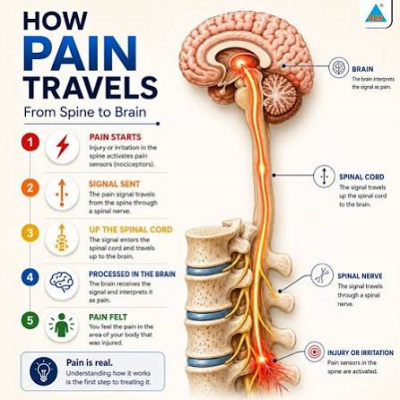
You lift a box wrong. Your back protests loudly for a few days, then seems to settle down. Three weeks later, you're barely bending over to tie your shoes and the pain feels worse than the original injury. Sound familiar? That gap between what happened to your body and how much your body is screaming about it confuses a lot of people, and honestly, it confused medicine for a long time too. The reason comes down to how pain signals travel to the brain: they follow a specific biological route that can get louder, get stuck, and stop reflecting reality.
Dr. Brian Short, DC, a Santa Fe chiropractor with nearly 40 years of clinical experience, sees this pattern constantly. Patients arrive with chronic back pain that has outlasted the original injury because the nervous system has shifted into overdrive and nobody has addressed the root cause. Below is a plain-English walkthrough of how pain actually travels from your spine to your brain, what happens when the system goes wrong, and what you can do about it.
Where pain signals to the brain actually start: nociceptors and your spine's alarm system
Pain doesn't begin in your brain. It starts at the injury site with specialized nerve endings called nociceptors, free nerve endings embedded in spinal discs, joint capsules, muscles, and ligaments. When a disc herniates, a joint locks up, or a nerve gets pinched, these receptors detect the mechanical and chemical stress and fire an electrical signal. Think of a bulging disc pressing on a nerve root as an alarm button being held down continuously. This process is called nociception, and it is the starting point of every pain experience.
The inflammatory chemicals released at an injury site make this worse. Prostaglandins, bradykinin, and substance P all activate nociceptors and lower their detection thresholds, which is why swelling amplifies pain. The more inflamed a tissue is, the easier it is to set off the alarm.
Two fiber types carry that alarm signal, and they work in very different ways. Aδ fibers are myelinated and quick, responsible for the sharp, localized "first pain" that tells your brain exactly where the problem is. C fibers are unmyelinated and slower, carrying the dull, burning, aching sensation that lingers long after the initial injury. C fibers mediate the slow, diffuse component of pain and are often prominent in prolonged pain states, which is why persistent back pain tends to feel like a foggy, constant ache rather than a clean, specific signal.
How pain signals to the brain travel up the spinal cord
Once nociceptors fire, those signals need a route to the brain. Second-order neurons in the spinal cord's dorsal horn pick up the signal from the primary fibers, cross to the opposite side of the cord, and ascend through the spinothalamic tract toward the thalamus. This is the lateral pain pathway, essentially your brain's GPS for pain. It tells the somatosensory cortex where the pain is, how intense it is, and what it feels like. Think of it as a very specific postal address delivering detailed sensory information about which body part is hurting and how badly.
Ascending pathways and the emotional response
Pain doesn't travel on just one highway. A parallel medial pathway, including the spinoparabrachial tract, bypasses the detailed sensory cortex and routes toward the amygdala, anterior cingulate cortex, and hypothalamus, the brain's threat-assessment and emotional-response centers. This pathway is why a bad back doesn't just hurt physically: it creates anxiety, disrupts sleep, and demands your full attention at the worst possible moments.
The brain isn't malfunctioning when it does this. It's responding exactly as designed when it detects ongoing tissue stress. The problem is that this system can become miscalibrated, and when it does, the emotional and sensory alarms keep firing even when they shouldn't.
What your brain does once pain signals arrive
The thalamus is not a passive checkpoint. It actively sorts, amplifies, or filters incoming signals before distributing them across the brain. The lateral pathway routes signals to the primary somatosensory cortex and posterior insular cortex, producing the sensory description of pain: where it is, how sharp or dull, how deep. This is the part that lets you point to the exact spot on your lower back that hurts.
In parallel, signals reach the anterior cingulate cortex, anterior insula, and amygdala, producing the unpleasantness, fear, and motivational urgency of pain. The sensory cortex answers "what is hurting," while the limbic system answers "how bad is this threat and what do I do about it?" Both streams are active simultaneously, which is why pain is never purely physical.
Descending modulation and amplification
Neurotransmitters shape this process at every level. Glutamate acting through AMPA receptors handles rapid transmission between neurons. Substance P, released mainly by C fibers, enhances excitability and prolongs the signal. When input becomes persistent, NMDA receptors get involved, allowing calcium to flood the postsynaptic neuron and triggering changes that make the entire system fire more easily. That last part is where things start to go sideways in chronic pain.
When the volume knob gets stuck: central sensitization and chronic pain
Here's where back pain gets genuinely complicated. Sometimes the nervous system stops accurately reporting an injury and starts amplifying every signal it receives. That process is called central sensitization, and it's not a metaphor, it's a measurable change in neural circuitry.
With persistent nociceptive input, NMDA receptors at the dorsal horn become increasingly sensitive. Calcium floods the postsynaptic neuron, excitatory synapses strengthen, and the system undergoes neuroplastic changes that make it fire more easily with lighter and lighter stimuli. The result is a nervous system that perceives threats where there are none. Pain spreads beyond the original injury site, light touch becomes painful (allodynia), a normal painful stimulus produces an exaggerated response (hyperalgesia), and pain persists long after the tissue has healed.
The brain's own pain-control system can also shift against you. The periaqueductal gray and rostroventromedial medulla form a built-in modulation network that can either suppress or amplify spinal pain signals. Normally, inhibitory neurons in this system use endogenous opioids, norepinephrine, and serotonin to quiet nociceptive transmission. But in chronic pain states, the balance tips: facilitatory neurons become dominant, and the brain actively makes pain louder rather than quieter. Stress and poor sleep both push the system further toward facilitation, which is why pain reliably flares during stressful periods even without any new physical injury.
To be absolutely clear: this is not imagined pain. The amplification is real and physiological. The problem is that the system has learned to be oversensitive, and that learning needs to be addressed directly.
Breaking the cycle: how reducing nociceptive input helps the nervous system reset
Understanding the pain pathway points directly toward what treatment needs to accomplish: reduce the incoming signal load so the system has a chance to recalibrate. As long as a compressed nerve, a dysfunctional joint, or an irritated disc keeps firing nociceptors, the spinal cord stays sensitized. To quiet central sensitization, the nociceptive input at the source generally needs to decrease, though effective treatment is rarely one-dimensional. Depending on the individual, reducing that input may involve chiropractic care, exercise, targeted anti-inflammatory approaches, or a combination of strategies tailored to the specific structural and neurological picture.
This is where the Activator Methods Chiropractic Technique becomes relevant. Dr. Brian Short uses this low-force, instrument-based adjustment to correct joint dysfunction without the twisting, cracking, or high-velocity thrusts of traditional manipulation. By restoring proper joint movement and reducing mechanical stress on nociceptors, the technique aims to decrease the constant barrage of pain signals hitting the dorsal horn. With less nociceptive input arriving, the spinal cord and brain may have a better opportunity to dial down their sensitized state, though individual outcomes vary and the full mechanisms are still being studied.
Dr. Short is a certified Activator Methods practitioner with four decades of clinical experience treating chronic spinal and extremity conditions. In cases where patients have been through physical therapy or other chiropractic care without lasting relief, persistent symptoms can stem from an unresolved structural driver, though in other cases, central sensitization or nonstructural factors may be playing the larger role. Accurate diagnosis is essential before choosing any treatment path.
What this means if you're living with persistent back pain in Santa Fe
Knowing how pain signals work is useful, but only if it leads to action. The first step is recognizing whether your pain has moved beyond a simple tissue injury. Ask yourself a few honest questions: Does your pain spread beyond where the original injury was? Does light touch or gentle pressure make things worse? Does your pain flare with stress or poor sleep even when you haven't done anything physically different?
These patterns suggest that central sensitization may be involved alongside the structural problem, a distinction that matters because it guides treatment. Research tools like the Central Sensitization Inventory can support clinical assessment, though no single test confirms the condition on its own. What's clear is that an approach focused entirely on masking symptoms may leave the upstream nociceptive driver unaddressed. The goal is to reduce the pain signals the nervous system keeps amplifying, and to give it less to work with over time.
The bottom line
You started with a confusing gap between how bad the injury looked and how bad the pain actually felt. Now you know why that gap exists. Pain signals to the brain follow a specific biological route, from nociceptors through the spinal cord, up the spinothalamic and spinoparabrachial tracts, through the thalamus, and into the sensory and emotional cortex. When that route gets overactive through central sensitization and a tipped descending modulation system, pain amplifies in ways that have nothing to do with willpower or imagination.
The good news is that the system is not permanently broken. The nervous system that learned to be oversensitive can learn to be less sensitive, but it generally needs the structural driver of nociceptive input to be properly identified and addressed first. Reducing that incoming signal load is the first real step toward giving the brain permission to quiet down.
That's exactly the kind of conversation Dr. Brian Short welcomes. If your pain has been lingering longer than it should, a proper structural and neurological assessment is a reasonable place to start, before resigning yourself to ongoing medication, injections, or surgery. Dr. Short offers complimentary consultations at his Santa Fe clinic at the Saint Francis Professional Center, with no referral required, for residents of Santa Fe and Northern New Mexico who want to understand their options and find out whether a targeted, low-force approach could help interrupt the cycle.
